
By Chandra Rai
The AI Summit, hosted by Progressive Ventures and Founders Creative, was an immersive experience that brought together my engineering and psychoanalytic perspectives.
I was honored to be one of the speakers. In my talk, I invited the room to consider that a company has a mind of its own, that every team carries anxieties no one names, and that the behavior we are tempted to debug may be doing a job we have not yet noticed. I offered no method, only a different kind of attention, and hoped people would leave a little curious about the company they thought they knew.
It was a particular pleasure to see the summit come together under Mala Ramakrishnan. Over the last few years, I have watched her grow as a leader, and it has been impressive to see. She set out to raise a $3 million fund and closed at $12.24 million, which she is now investing in seed-stage B2B AI founders. What she looks for in them is telling: domain expertise and, ideally, a track record of exits, which is exactly what she brings as a three-time founder herself.
Her commitment to women is just as clear. Mala has said she wants to help send at least one woman-led startup to an IPO every year, and the fund looks to back startups with at least one underrepresented founder, specifically women. Through her nonprofit initiative, Founders Creative, more than 40,000 founders, investors, and executives come together, and that network makes the goal practical rather than aspirational.
Women remain a small minority of venture partners and founders. Her approach is that exceptional founders exist everywhere, and someone has to open the doors. It struck me that she builds the way the best holding environments do, making room for potential that has not yet had a place to thrive.
It was inspiring to watch young entrepreneurs present their companies with pride and enthusiasm. Each shared their journey (personal, professional, and financial) and ended with a clear ask for how the community of executives and investors could support them. The intergenerational and peer support was evident.
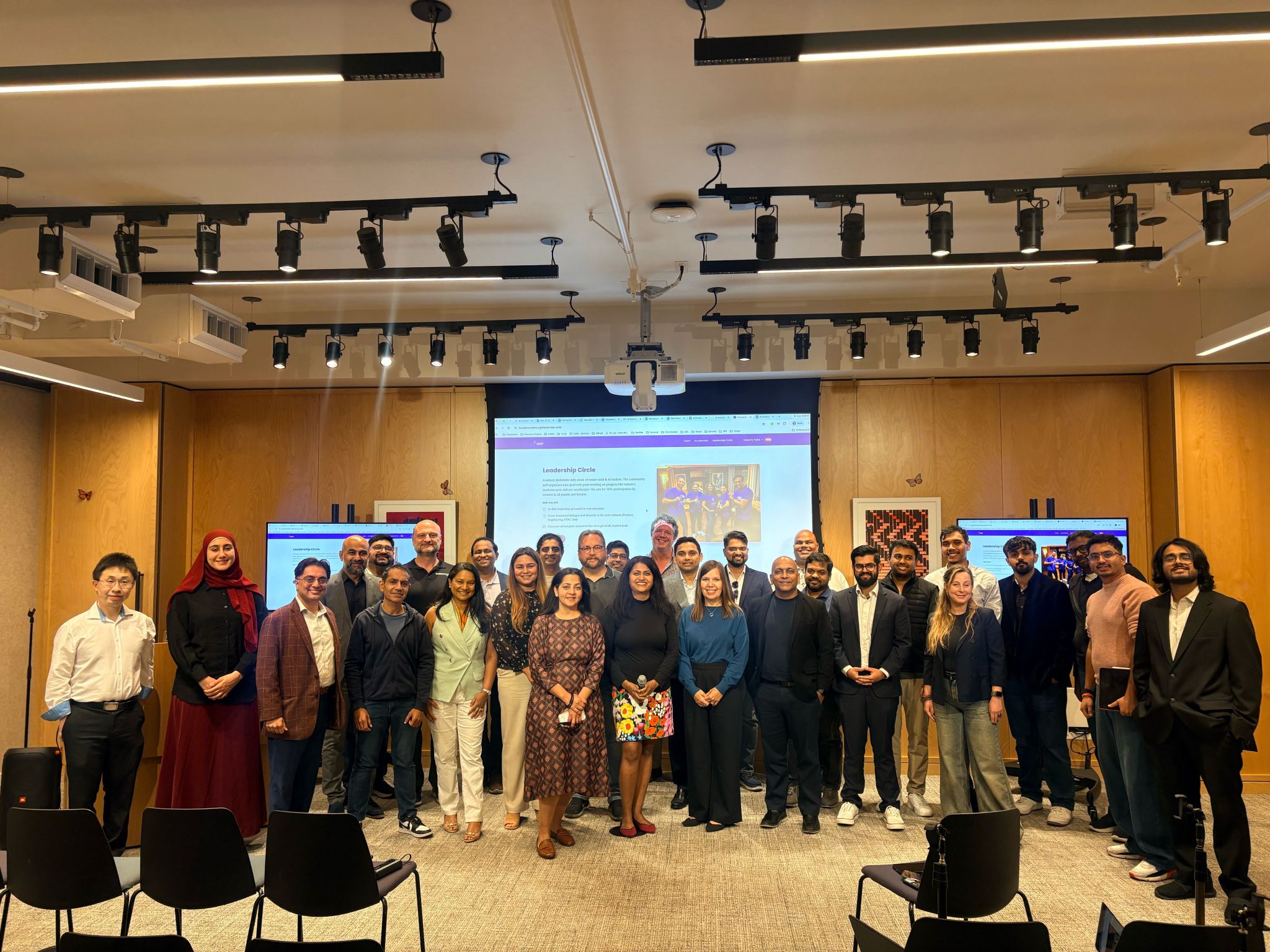
As the summit presentations rolled by, one thing stood out for me: my consulting room and the “Huddle” room on the Google campus had something in common. What was being shared were stories. Human stories, people’s journeys, whether it was a roadmap, the company name, the birth of an idea, or the integration of AI into the everyday lives of engineers. Within this matrix was also the story of how to remain human in the fast-growing world of artificial intelligence.
One story was about an interview for an engineering position in which the questions were drafted by AI and the candidate was looking for AI cues, so two humans were speaking to each other, but through AI models. It reflects a wider pattern: a 2026 Resume Genius survey found that nearly half of hiring managers have seen candidates use AI to answer interview questions.
The caution was to consider government regulations when using AI in hiring, and to remember that AI can create an entire persona to appear online. “Ask them to wave their hands in front of their face” and “What is their favorite restaurant in the neighborhood?” were said jokingly, but with complete seriousness at the same time.
“Being Human” has become the central story in many rooms: in conversations between mothers and sons, in the aftermath of the alleged assault at a Cornell fraternity house, where parents are asking why no one intervened (New York Times, Oct. 1, 2026), in the company boardroom, and in classrooms where teachers debate how much AI young minds should be exposed to. Parents have also voiced concern that the current generation is questioning whether it is even worthwhile to learn programming. How, and how much, is critical thinking being affected by the use of AI?
What stayed with me was how each venture had a personal beginning. These young entrepreneurs began their business in the very place they had already lived, in the industry, doing the exact same work and feeling the challenges of the business firsthand.
There were many remarkable companies at the summit, and in the interest of space I can only highlight a few here, with no judgment intended toward the ones I’ve left out.
Hemut began with friendships formed in a dorm. Its founder, Loki Cheema, came to software through trucking experience itself. His story started with helping truck drivers who were not fluent in English with their paperwork, whether an insurance license or a business license. He then grew his business into running a dispatching operation. In his talk, he shared how the entire engineering team lived in remote rural towns across the US to understand how a trucking company really works. He emphasized that learning the workflow by sharing the life was crucial, rather than writing software in an office building without understanding the challenges on the road. Hemut echoes the Hindi word himmat, which means courage, a brave heart. He confirmed that the name originates from the Hindi word and that he had anglicized it. It seemed fitting for founders building technology for a community often underserved by it.
Rimba‘s founder, Timothy Daniel, shared that he is from Indonesia, where rimba means jungle. The metaphor seemed a fitting name for a company built to help people find their way through overgrown terrain of regulation. He shared that before business school, he was head of compliance and legal counsel at an energy and mining company, where he spent years navigating regulations, environmental certifications, and audit preparation across spreadsheets, PDFs, and operational data. He also worked through the problem before he built a solution.
In psychoanalysis, we say that lived experience is what makes way for the creative process. Thomas Ogden, a psychoanalyst in San Francisco, explores in Reclaiming Unlived Life: Experiences in Psychoanalysis (Routledge, 2016) how parts of ourselves are lost when experience, especially trauma, goes unlived, and how analysis can help us reclaim them. Freud described two classic ways we defend against such experience. In one case, we repress the memory, but the emotions around it flood us. People become emotionally hijacked and unable to step back from their feelings to think. In the other case, we repress the feeling, and the memory haunts us instead. Think of obsessional neurosis, in which a person becomes preoccupied with organization and structure as a way of not losing control, so that emotions never take them by surprise.
Like Hemut, Rimba is a story of friendship. Timothy and his co-founder and CTO, Shivam Dixit, had both worked in regulatory compliance, and they bonded over the struggle. Timothy joked that he had to convince him to walk away from his own startup idea to join him. Together they won about $175,000 in prizes at Berkeley startup competitions and were accepted into Y Combinator in 2025.
Both the Hemut and Rimba stories carried a kernel of truth I recognize from my own consulting room: what endures tends to grow out of lived experience and relationship. Even the places where young people live together, which in one story became the scene of an alleged assault, were stories on another end of the human spectrum that held the beginnings of friendship and trust.
I also met a young woman from Jordan who spoke passionately about building communities and creating a safe space on campuses for young women to come together and discuss. She hosted discussions on Arabic philosophy and had read Lacan and Freud. Winnicott, a British psychoanalyst, writes about a holding environment, a space reliable enough that a person can begin to think and feel without fear of falling apart. The safe space she is building for young women on campus is exactly that: a place where stories can be told and received.
Creativity tends to follow wherever people feel held.
I was struck by the depth with which she reflected on life, and by her passion for living with intention. In the space she was creating, experience would not be left unlived. It would be spoken, heard, and held by others. She and her co-founder have known each other since high school.
A panel of women product managers spoke about how the job description of a product manager is changing with AI tools. The theme mirrors what industry research is reporting: AI is taking over much of the production work, such as drafting, synthesizing, and reporting, and the role is shifting from executor to orchestrator, with more weight on judgment, prioritization, and understanding customers.
Throughout the summit, I met young people who combined technical sophistication, business savvy, and eloquence with a hunger for meaning. Alongside their companies, they were building communities. They asked what it means to live well and to contribute to their community, and they were willing to tell their stories openly. At a time when many of us worry that AI will do our thinking for us, they showed me the other side of the mirror: a generation using the new tools while still reaching for the old human questions.
Across the summit, I was struck by the diversity of thought, industries, companies, gender, and age in the room, something I have always cherished about the engineering community. I left more hopeful than I arrived.